
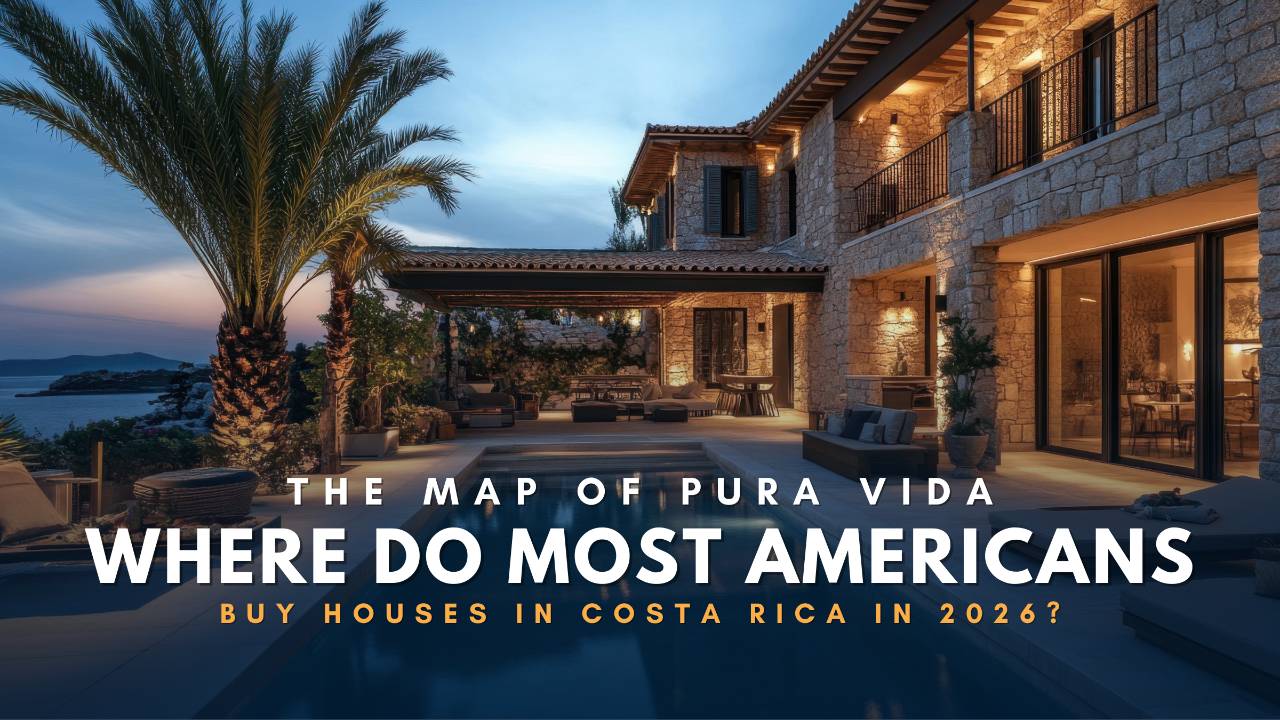
The Map of Pura Vida: Where Do Most Americans Buy Houses in Costa Rica in 2026?
If you were to overlay a map of American property ownership onto the rugged topography of Costa Rica today, you wouldn't see a scattered set of dots. Instead, you would see three distinct, high-density "constellations."
By 2026, the migration of North Americans to the land of Pura Vida has matured from a retirement trend into a diverse movement of digital nomads, young families, and lifestyle investors. However, Americans aren't buying just anywhere. They are gravitating toward specific "micro-markets" that offer a unique blend of familiar comforts—like high-speed fiber optics and international schools—and the exotic allure of the tropics.
Whether you are looking for a surf-side villa or a mountain-view estate, here is exactly where most Americans are planting their roots in 2026.
The "Gold Coast" of Guanacaste: The Epicenter
Guanacaste remains the undisputed heavyweight champion for North American buyers. Its popularity is fueled by a simple logistical advantage: the Daniel Oduber Quirós International Airport (LIR) in Liberia. For an American buyer, being able to touch down and be in your private pool within 45 minutes is a massive selling point.
- Tamarindo & Playa Langosta: Often called "Tamagringo" by locals, this is the most developed hub. In 2026, it is the primary choice for investors seeking high rental yields. Americans buy here for the "walkability"—the ability to stroll to high-end sushi, boutique gyms, and world-class surf breaks without needing a 4x4.
- Playa Flamingo & Potrero: With the full completion of the Flamingo Marina, this area has become a magnet for the yachting crowd and high-net-worth individuals. Most Americans here opt for gated luxury communities like Mar Vista or Las Catalinas, which offer a "car-free" European village feel on a tropical coast.
- Nosara: This is the "Wellness Capital." Americans moving here tend to be younger, health-conscious, and eco-minded. It is the most expensive per-square-meter market in Guanacaste, known for its strict building codes that keep the jungle canopy intact.
The Central Valley: The "Eternal Spring" & Urban Hub
While the beaches get the brochures, a significant portion of the roughly 70,000 Americans living in Costa Rica reside in the Central Valley. This is where "real life" happens, offering the best healthcare, shopping, and year-round spring-like weather.
- Escazú & Santa Ana: Known as the "Beverly Hills of Costa Rica," these suburbs of San José are where American executives and embassy staff congregate. You’ll find luxury high-rise condos and gated communities within walking distance of Avenida Escazú, an upscale district featuring Tesla chargers, Starbucks, and international fashion brands.
- Atenas & Grecia: National Geographic once called Atenas the place with the "best climate in the world." Americans buy here to escape the heat of the coast. These towns offer a "Mayberry" feel—safe, quiet, and filled with "gentlemen’s farms" where you can grow your own citrus and coffee.
- The Appeal: Most Americans in the Central Valley are full-time residents or retirees who prioritize proximity to JCI-accredited hospitals like CIMA or Clínica Bíblica.
The Southern Zone: The Nature Lover’s Frontier
If Guanacaste is for the resort-seeker, the Costa Ballena (Uvita, Dominical, and Ojochal) is for the adventurer. This region has seen the highest percentage growth in American interest over the last three years.
- Uvita: Famous for its "Whale’s Tail" sandbar, Uvita is the current darling of the Southern Pacific. Americans are buying "mountain-ocean view" homes here—properties perched on steep hillsides that offer a cool breeze and a view of the sunset over the Pacific.
- Ojochal: Originally a French-Canadian enclave, Ojochal is now a multicultural "foodie" haven. Americans are drawn to its larger, more private lots and the lack of "high-rise" development.
- The Draw: In 2026, Americans are moving south to find what Guanacaste used to be: more jungle, more privacy, and a slightly lower entry price point (though that gap is closing fast).
Emerging Clusters: The Caribbean and The Lake
Beyond the "Big Three," two other areas are seeing a localized surge in American ownership in 2026:
- Puerto Viejo (Caribbean Side): Once considered too "rustic," the Caribbean coast is attracting a younger, more bohemian American demographic. The draw here is the Afro-Caribbean culture and the relatively affordable (though rising) prices compared to the Pacific.
- Lake Arenal: For those who prefer freshwater and volcanic vistas, the towns of Nuevo Arenal and Tilarán offer a lifestyle reminiscent of the Pacific Northwest but with tropical temperatures. It is particularly popular with retirees looking for "Swiss-like" landscapes and a lower cost of living.
The 2026 Buyer's Profile: Gated vs. Standalone
A key trend in 2026 is that 80% of Americans now prefer gated communities (urbanizaciones cerradas). While "living like a local" in a standalone Tico house was the dream in the 90s, modern buyers prioritize:
- Security: The peace of mind of 24/7 guarded entrances.
- Infrastructure: Guaranteed water letters and underground fiber-optic lines.
- Community: Social clubs, shared pools, and a community of peers who share the expat experience.
Conclusion: Why These Places Matter
Americans aren't just buying "houses" in Costa Rica; they are buying access.
In Guanacaste, they buy access to the airport and the ocean. In the Central Valley, they buy access to first-world medical care and urban culture. In the Southern Zone, they buy access to the raw, unfiltered biodiversity that made Costa Rica famous.
The "best" place is entirely dependent on your personal "Pura Vida" formula. Are you here for the surf, the social scene, or the solitude? As the 2026 market shows, there is now an established American footprint in every corner of this paradise, ensuring that wherever you choose to land, you won't be navigating the jungle alone.


